


EGF is no longer an unfamiliar name in the scientific skincare community. With its excellent benefits in anti-aging and repairing damaged skin, this ingredient is a promising candidate that beauty enthusiasts should incorporate into their anti-aging routine.
So, what is EGF? What are its effects? Is it safe? Let's explore these questions in this article.
1. Overview of EGF
Human epidermal growth factor (hEGF), a polypeptide hormone found in the human body, is widely used in the pharmaceutical and cosmetic industries. Growth factors play a crucial role in regulating cell growth, proliferation, and differentiation. With its ability to stimulate the synthesis of DNA, RNA, hydroxyproline, and hyaluronic acid, it accelerates cell proliferation and the differentiation of various epithelial tissues, such as the epidermis of the skin, the gastrointestinal tract, and the cornea.
EGF not only stimulates cell proliferation, differentiation, and migration but also plays an extremely important role in wound healing, organ regeneration, and cell signaling.
EGF was first isolated from the submaxillary gland of mice in 1960 by Stanley Cohen. In 1986, Stanley Cohen received the Nobel Prize 4 for his work in elucidating the role of EGF in regulating cell growth and development. Cohen's and his colleagues' research demonstrated that EGF directly stimulates the proliferation of epidermal cells, and these stimulatory activities of EGF are independent of systemic or other hormonal influences.
Mechanism of action:
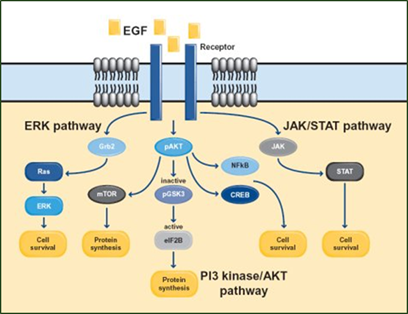
Diagram of the EGF-stimulated cell signaling pathway
EGF primarily stimulates cell proliferation, differentiation, and survival through the epidermal growth factor receptor (EGFR). When EGF binds to its receptor, it initiates a cascade of amplified molecular reactions through the MAPK/ERK pathway, leading to cell division and ultimately to DNA expression of a protein in the nucleus, causing several changes in the cell. This results in the following effects:
- Regulates cell proliferation, function, and differentiation through a signal-receptor mechanism.
- Directly impacts the biosynthesis of collagen, elastin, and the extracellular matrix (ECM).
- EGF applied to the dermis of aging skin can promote fibroblast proliferation and restore fibroblast synthesis capabilities.
This helps accelerate recovery, increase regeneration speed, slow down the aging process, and inhibit wrinkle formation.

Anti-aging mechanism of EGF
Furthermore, EGF has been found to be an antagonist of the nitro gene, which reacts and produces reactive oxygen intermediates by keratinocytes, and also has an inverse effect on the growth inhibitory effects of inflammatory mediators. This helps accelerate wound healing. EGF has also been shown to help heal diabetic ulcers. It is applied in both the medical and cosmetic industries.
2. EGF in the treatment of atrophic scars
Prolonged inflammation and abnormal collagen formation are the main causes of acne scars. There are three types of acne scars: icepick scars, rolling scars, and boxcar scars.
Subcision, chemical peels, fractional CO2 laser, and mesotherapy are common treatment methods for atrophic scars today. These methods all rely on the principle of creating micro-injuries in the skin to stimulate collagen production to fill the scars. Therefore, skin after treatment requires intensive care to accelerate the healing and recovery process.
Epidermal growth factor (EGF) is a polypeptide with 53 amino acids. It is secreted by platelets, macrophages, fibroblasts, and bone marrow-derived mesenchymal stem cells and is found in body fluids. EGF plays a crucial role in stimulating epithelial and fibroblast differentiation, enhancing collagen synthesis, and supporting wound healing. Recent studies have shown that topical EGF can improve acne scars by enhancing collagen synthesis.
Fractional CO2 laser can emit energy to create multiple microthermal treatment zones in the skin and surrounding untreated tissue. The laser deploys 10,600 nm wavelength radiation to selectively destroy specific cells. Consequently, the stratum corneum, epidermis, and dermis can be deteriorated. By inducing skin damage and stimulating new collagen formation, this device has proven effective in treating acne scars. However, studies have shown varying degrees of treatment outcomes, from mild to moderate clinical improvement. Additionally, some unwanted side effects, including redness, edema, and pigment changes, persist.
To achieve the best clinical results with fewer side effects, topical EGF is used in combination with Fractional CO2 Laser for acne scar treatment. Both therapies can stimulate collagen synthesis. Furthermore, EGF reduces desquamation time and unwanted side effects, such as redness and edema, by promoting wound healing after laser treatment. Moreover, some studies have shown that micro-injuries created by Fractional CO2 Laser penetrating the skin can facilitate the penetration of topical medications.
21 patients completed the trial. According to the skin analysis system and dermatologist classification, EGF showed superior efficacy at three months post-treatment compared to placebo. Wound healing responses did not differ between groups. Surprisingly, the melanin index significantly decreased with EGF after three months of treatment, compared to placebo. No reports of EGF causing irritation.
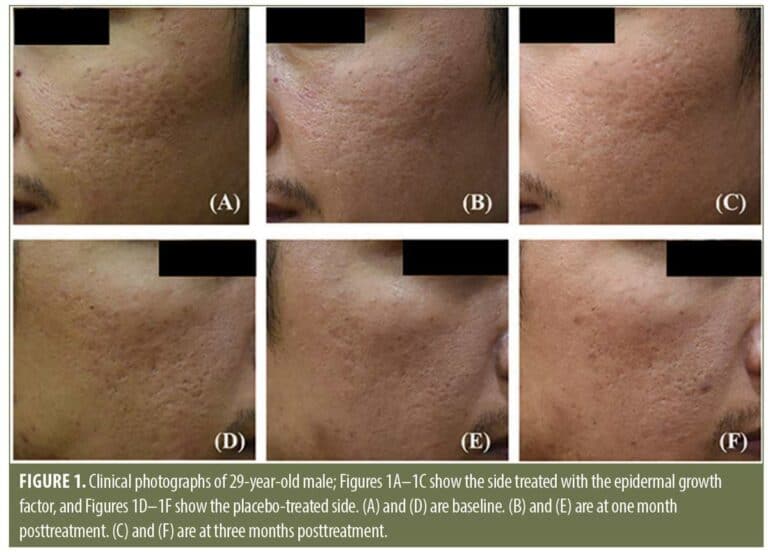
In a study on the use of topical EGF after scar treatment with microneedling, Kalil, Frainer, and colleagues (2015) selected 10 patients aged 20-40, both sexes, with acne scars, who underwent three microneedling treatments with 2mm needles, using a mask containing growth factors (EGF, IGF, TGF-beta3). The results showed an overall improvement in skin texture, especially in patients who used EGF after two microneedling treatments.

3. EGF in anti-aging skincare:
When young, the body can produce enough EGF to promote epidermal cell growth, but as age increases (after 25), EGF production gradually decreases, and epidermal cell renewal noticeably slows down. EGF deficiency leads to slow wound healing, scarring, skin aging, and the formation of wrinkles, freckles, and melasma.
EGF plays an important role in reversing the effects of skin aging due to time and environmental factors. Excessive oxidation of intra- and extracellular components leads to the breakdown of collagen and elastin networks in the dermis and causes the effects of facial skin aging.
Topical application of growth factors in many clinical studies has been shown to reduce the signs and symptoms of skin aging, including a significant reduction in the formation of new wrinkles and existing fine lines, and an increase in collagen synthesis in the skin.
The EGF content in the body determines the age of the skin. Therefore, EGF is also known as the "Beauty Factor" and is widely used in skincare cosmetics with the following functions:
- Skin rejuvenation: EGF promotes skin cells to absorb nutrients, accelerates cell metabolism, increases cell division and growth, and stimulates the synthesis of hyaluronic acid and glycoproteins. Products containing EGF are also effective in improving outcomes after cosmetic and dermatological procedures.
- Accelerates cell regeneration and tissue repair: EGF promotes the healing of skin and mucous membrane wound surfaces, reduces scar contracture, and abnormal skin proliferation. It is highly effective for scars, especially post-acne scars.
- Evens skin tone: EGF can promote the growth of new cells to replace cells damaged by UV radiation, reducing the number of melanocytes in the skin.

Rh – EGF promotes cell migration and proliferation of epithelial/endothelial cells with similar activity levels as standard EGF.

Sh-oligopeptide-1 experimental results: improved eye wrinkles after 4 weeks of use

EGF is effective in fibroblast proliferation
4. What makes a quality EGF product?
Natural EGF is rare and expensive, so industrial production of EGF in sufficient quantities to meet increasing demand is essential. Applying molecular biology techniques – recombinant technology – on an industrial scale to produce commercial recombinant hEGF through various hosts, most commonly through E.coli.
These products are named Sh-Oligopeptide-1 (Sh-EGF, Synthetic Human Epidermal Growth Factor) or Rh-Oligopeptide-1 (Rh-EGF, Recombinant Human Epidermal Growth Factor). Sh-Oligopeptide-1 is synthetic EGF produced using genetic engineering technology. Its guaranteed purity is > 95%.
Synthetic EGFs are similar to human EGF, so they can be used as an optimal alternative for the body, especially for the skin. They have the advantage of clear and transparent ingredients – precise concentrations. The supply of synthetic EGFs is less controversial than human growth factors.
4. Products containing EGF
Currently, the oh!oh! brand owns two products containing Epidermal Growth Factor (EGF) at a concentration of 9.9ppm (the highest on the market), combined with other advanced active ingredients to optimize their effectiveness on the skin:
oh!oh! Oatmere Serum (with 4.5% Oat Extract & 9.9ppm EGF) - Stem Cell, Skin Regenerating Serum
oh!oh! Oatmere Serum is a stem cell, skin regenerating serum with a formula containing:
- 4.5% Oat Extract to soothe, anti-inflammatory, and heal skin damage.
- 9.9 ppm EGF (growth factor) to improve old wrinkles and reduce the appearance of new ones, stimulate epidermal cell division, and promote elastin production, restructuring the skin.
This serum is suitable for pre-aging skin, sensitive skin, and skin after treatment or cosmetic procedures.

oh!oh! Flawless Abyss Serum (with 1.2% GHK-Cu & 9.9ppm EGF) - Atrophic Scar Reduction Serum
oh!oh! Flawless Abyss Serum is an anti-aging serum that maintains long-lasting youthful radiance with a formula containing a brilliant duo of active ingredients: Copper Tripeptide-1 (GHK-Cu) and EGF (growth factor).
High-tech peptides are present in the ingredient list at a concentration of 1.2%, helping to "neutralize" free radicals, repair damaged cells, and stimulate the production of important skin components such as Collagen, Elastin, and Glycosaminoglycans, thereby improving skin elasticity, firmness, and reducing wrinkles.
9.9 ppm EGF helps improve old wrinkles and reduce the appearance of new ones, while stimulating the skin to accelerate cell regeneration and restructure the skin, thereby nourishing healthy skin.
Specifically, the product offers 4 effective actions on the skin:
- Enhances and promotes cell regeneration;
- Effectively reduces acne, improves skin texture, and smooths;
- Soothes sensitive skin, anti-inflammatory, reduces irritation, and redness;
- Controls oil secretion, restores skin balance.


